#13 Middle Management course 4.3 total satisfaction score

On St. Maarten a Middle Management course was organised for 14 healthcare professionals from 5 institutes of three Caribbean islands: Saba, Statia and St Maarten. The course was about strategic planning on departmental level; on leadership and follower-ship and on giving, receiving and asking for feedback.

The participants rated their satisfaction for the course overall with  4.3 on a five point scale.  In the remarks it was emphasised that it is a surplus to have this training together with other HC organisations in the region. Of course there is room for improvement. One participant suggested next time “to kick it up a notch”. The extent to which the participants felt better equipped for their job scored a 4. The trainer scored 4.2 on training competencies and 4.3 on content knowledge. Eleven of the fourteen participants stated that they would surely recommend this course to others, two answered very likely, one would likely recommend the course to others.

#12 New instrument for Total Quality Management

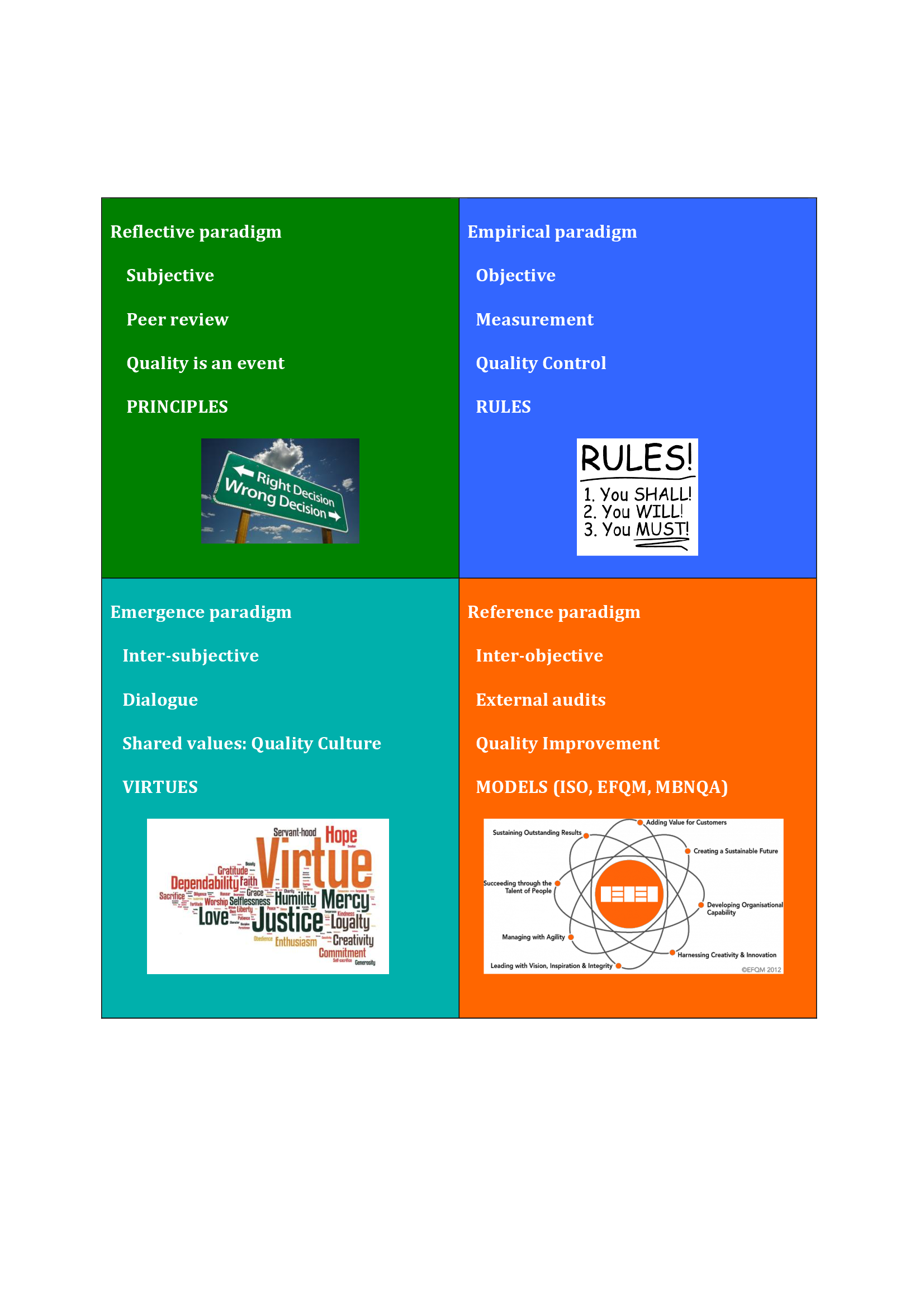
“Feed it, burp it and put it to bed, ’cause this baby’s done”. On the 22nd  of October my latest publication about the R2E2 – Model © for Total Quality Management was ready. R2E2 stands for Reflection, Reference, Empirical and Emergence. These are the four paradigms that constitute Total Quality Management, in my definition of the term. Ideally an organisation can use all four paradigms (see posts  11, 9 and 5) situationally, when needed depending on the context. The R2E2-Model © gives an organisation the opportunity to see to what extent all four paradigms are represented in its planning and actions. The version of the R2E2-Model © is focused on healthcare organisations and will be used on the second meeting of SYNERGY in a workshop. A sample of the R2E2-Model © for Total Quality Management can be downloaded here.

#11 New notion of Total Quality Management

In literature about Total Quality Management (TQM) we find lots of definitions. A literature review by Miller (1996) ended up with the following definition: TQM is “an ongoing process whereby top management takes whatever steps necessary to enable everyone in the organization in the course of performing all duties to establish and achieve standards which meet or exceed the needs and expectations of their customers, both external and internal”. The concept of totality is expressed by the words “everyone in the organisation”. That idea got much support by quality gurus like Deming, Juran, Crosby, Feigenbaum and Imai.  I would be the last to argue against quality experts like this. And I do agree that  it is crucial that everyone in the organisation is involved in quality management. Like Imai says, Kaizen is everyone, everywhere, every moment improvement.

However there is another valid explanation for the concept of totality in TQM: the one of a totality of the different paradigms as discussed earlier in posts 5 and 9 on this website. Kemenade and Hardjono (2018) discern 4 paradigms, that can be combined in the R2E2-Model(c):  the Reflective paradigm, the Reference paradigm, the Empirical paradigm and the Emergence paradigm. Total Quality Management in that sense means that one has the flexibility to use different paradigms and their concepts, models and tools in different contexts.
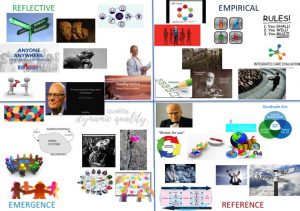
Actually we are talking about epistemic fluency. Epistemic fluency is mentioned by Markauskaite and Goodyear (2016) as the capacity to understand, switch between and combine different kinds of knowledge and different ways of knowing about the world. They state that “Working on real-world problems usually requires the combination of different kinds of specialised and context-dependent knowledge, as well as different ways of knowing. People who are flexible and adept with respect to different ways of knowing about the world can be said to possess epistemic fluency.” If we talk about an organization that would mean Total Quality Management.


References

Kemenade, E.A. & Hardjono, T.W. (2018) Twenty first century Total Quality Management: the Emergence paradigm, Total Quality Management Journal, under re-review

Markauskaite, L., & Goodyear, P. (2016). Epistemic fluency and professional education: innovation, knowledgeable action and actionable knowledge. Dordrecht: Springer.

Miller, W.J. (1996) , Working definition of total quality management, Journal of Quality Management, Vol 1, No 2, 149-159

#10 Second SYNERGY meeting: 5th November on Statia

On the 5th of November the second meeting of SYNERGY, the Caribbean Network of Leadership in Healthcare will be held on Statia, in the Caribbean Netherlands Science Institute.

The meeting is organised in cooperation with Queen Beatrix Medical Centre. Main topic is Quality. Keynote speaker will be Carol Jack, director of Maatschappij en Welzijn op Sint Eustatius. More information can be found on SYNERGY.


#9 New insight on quality paradigms

During the fourth training on Sint Eustatius in April, that again was very successful, I got an insight that is worthwhile mentioning. It relates to the quality paradigms that I illustrated in blog # 5 (using Donald Trump as an example).

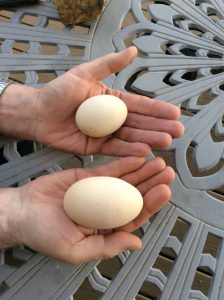
In the course I explained the four paradigms with the  following four characteristics: the empirical paradigm is the one of RULES. (A guy like Trump does not take objective scientific measurement seriously e.g regarding global warming. He is not into the empirical paradigm, does not follow rules). The reflective paradigm is the one of PRINCIPLES. (Trump is not into the reflective paradigm. He does little reflection, but acts -sometimes impulsively). The emergence paradigm is the one of VIRTUES. (Trump is not into the emergency paradigm either in  which you hold a serious dialogue with all stakeholders).   The reference paradigm is the one of MODELS. (At his best Trump follows the reference paradigm. He believes in a model, not in democratic nor republican models, but his own). The distinction between Rules, Models, Principles and Virtues appeared to help participants to understand the difference between the paradigms!Recently Huub Vinkenburg asked Hardjono and me, if we could describe an egg from each of the four paradigms. Well the egg as an object does not change when you look at it from different paradigms. What changes is the way we judge its quality.
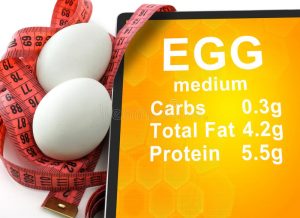
From the empirical paradigm we would measure how big the egg is, weigh it according to the rules and we would measure the carbs, fat and protein or even the amount of fipronil in it.

From the reference paradigm we would compare the egg to an ideal image, a model of an egg and judge how far away this one is from the ideal.

From the reflective paradigm experts would discuss and compare the qualities of the egg at this moment and then state to what extent this egg complies to the subjective ideas and principles the group members have about a good egg. That quality is then determined.

From the emergence paradigm all stakeholders will be involved in a virtuous dialogue on the egg and provisionally determine its quality, that is regularly being questioned again.