#60 PEACE: Client Centred Care at White and Yellow Cross Care Foundation

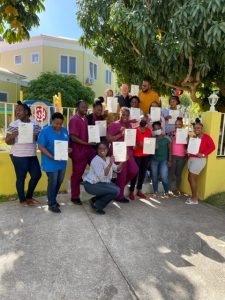
From 21st till 24th and from 28th till 31st of March two groups of staff members from different roles and functions have been trained in client centricity, one of the core values of the White and Yellow Cross Care Foundation (WYCCF) on Sint Maarten. The discussions on the topic were lively, the contributions of staff members valuable. As always in this course the participants conduct an interview with clients to know their life story and as a result they produce a poster.

This time beside the posters an interview was held and recorded with a group of stakeholders within the foundation to get to know their ideas on client centricity.

Important conclusion of the trainings was that there still are some differences in interpretation of client centred care (CCC) or differences in vision what it means for WYCCF.  For that purpose a  discussion paper will be produced with the title PEACE, the five pillars of client centricity: Participation of clients; doing something Extra for all; creating am Atmosphere of happiness; teaching clients how to Cope with their situation and doing something Extra for one. This discussion paper will finally lead to a shared vision of the foundation on CCC.
“True happiness comes from having a sense of inner peace and contentment, which in turn must be achieved by cultivating altruism, love, and compassion, and by eliminating anger, selfishness, and greed.”

Tenzin Gyatso, The Dalai Lama
 

#59 Client Centred Care in the Caribbean again!

The last few years Van Kemenade ACT has been active in the Caribbean supporting the establishment of Client Centred Care. The frontrunner in this process is the White and Yellow Cross Care Foundation (WYCCF) from Sint Maarten. For more information on WYCCF see their facebook page here or their website.

After COVID-19 we now can continue training. In spring the next two trainings will take place for again over thirty people to help them to deliver person centred care. Part of the training is a life story project in which residents and clients will be interviewed to get to know their history, their situation today and their wishes. Aim is, even more than has already been done, to delight the client!

Another day will be spent to work with managers and unit leaders to cascade down  the organisation wide strategic goals.


In the same period Sint Maartens’ Home will be audited by the internal audit team and Sister Basilia Centre (SBC) will work on its vision to become the SBC Village.

We are looking forward to this great assignment!


#58 Last year I had the most citations ever…

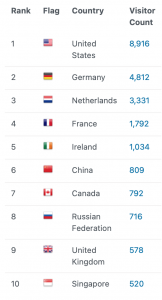
In 2021 I had a very fruitful year. When I look at the statistics of my website  I had 32.686 visits that year. That is especially thriving, if you relate that figure to the all time total of 65.855 visits. Besides the home page, the page of SYNERGY and the publications and citations were most visited.

Most visitors are from The United States of America, Germany and the Netherlands.

I published 5 articles in English and an English book chapter and three articles in Dutch of which I was the (co-)author and a Dutch book chapter.

I had the all time high of citations of my publications as well.  (I follow the amount of citations of my articles that Google Scholar registers. Not because I think that being cited is the best indicator for the quality of a researcher, but quotations do tell me, that my articles are read and used for further reflection and research).

Hundred and five citations last year. This is way beyond the years before. In future I hope to continue writing on topics that interest scientists and practitioners in Quality Management. The focus for the next year will be Leadership for Emergence.


#57 Co creation of robust research on the relationship between leadership and emergence

Emergence, the rise of novelty out of interaction between a diverse group of actors, has been my research topic since the last few years. I mentioned emergence in many of my blogs of this website and wrote several articles on the topic. More recently my focus deepened into the relationship between leadership and emergence. My main question is: How can leadership facilitate emergence leading to (radical) innovation? This year, I have published three articles* on the subject, all what you could call ‘rapid reviews’.

It is time now for a more robust research. Today, I had a discussion with a very gifted colleague of mine, Josien Engel, who mentioned my “almost childish curiosity” about how leadership and emergence relate. She is a distinguished researcher on leadership and she told me she shares the interest in emergent leadership, especially in the complex and uncertain times we live in. I am happy to announce that Josien and I agreed to co-create the needed robust research together!!!

* The three articles

Van Kemenade, E.A. (2021), Education and Training in Emergent Leadership, The Journal of Quality in Education 11(18), 149-176

Van Kemenade, E.A. (2021), The Leadership Complexion, Quality Progress, 54 (11), 32-37

Van Kemenade, E.A. (2021), Emergent leadership and the Medusa principles, Journal of Research in Business Studies and Management, 8(2), 1-9


#56 Emergent leadership and the six principles of Medusa

Innovation often ’emerges’ without anyone ‘in control’. The outcome, however, can be crucial for the sustainability of an organisation in times of complexity and uncertainty.  What can leadership do to facilitate this emergence? An exploring literature review reveals six factors: Enable, Share values, Dream, Interact, Be Context sensitive and Adapt. Read the article here.

In Dutch the principles sound like:  Mogelijk maken, Eenheid smeden, Dromen, Uitwisselen, de context opSnuiven en Aanpassen. Together these form the word Medusa.

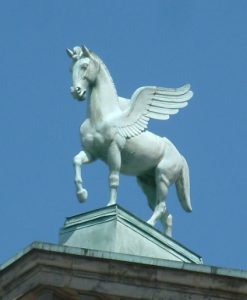
Medusa was a Greek lady that was raped by Poseidon, punished by Athena (in stead of punishing him) and finally beheaded by Perseus. However, the blood that poured out of her head mingled with the water from the sea and these two co-created an innovation: Pegasus, the marvellous flying horse, that became an important helper for Zeus, the supreme god.

Pegasus on the Opera House in Poznan